Table of Contents
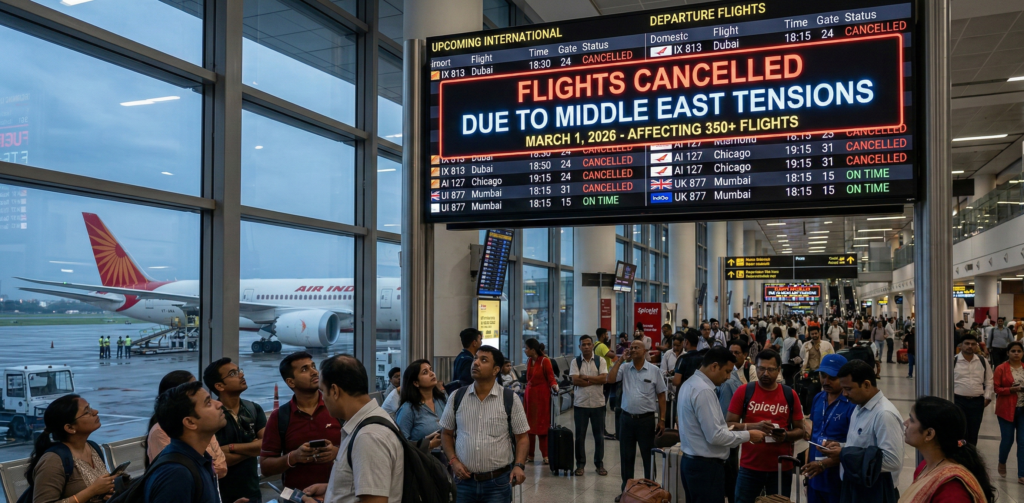
India’s aviation sector faced major disruption on March 1, 2026, after more than 350 Indian flights were cancelled due to ongoing airspace restrictions over the Middle East. The cancellations affected both domestic and international routes, creating significant inconvenience for passengers across major airports including Delhi and Mumbai.
The move came as precautionary safety measures amid rising geopolitical tensions in the region.
Why Were 350+ Indian Flights Cancelled?
According to the Ministry of Civil Aviation (MoCA), a total of 350 flights operated by Indian carriers were cancelled on March 1.
Earlier estimates suggested that up to 444 flights could be impacted. However, the final number was slightly lower after operational adjustments.
This followed 410 flight cancellations on February 28, indicating the continued impact of restricted Middle East airspace on Indian aviation.
Airlines were forced to reroute aircraft or suspend operations on certain routes due to safety advisories.
Which Airlines Were Affected?
Several major Indian airlines were impacted by the sudden restrictions.
Air India Flight Cancellations
Air India announced flexible travel measures for affected passengers. The airline offered:
- Full refunds
- Free rescheduling
- Waiver of change fees for eligible bookings
Passengers travelling to and from Middle Eastern destinations were particularly affected.
IndiGo Flight Disruptions
IndiGo also issued waivers for impacted travellers. The airline allowed:
- Free date changes
- Fare difference waivers in select cases
- Refund options for cancelled services
The flexibility window was extended for bookings made before the disruption announcement.
SpiceJet Operations
SpiceJet also cancelled certain services between India and UAE routes as a precautionary measure.
Impact on Delhi and Mumbai Airports
India’s busiest airports experienced operational pressure due to cancellations and rerouting.
Delhi Airport Updates
Indira Gandhi International Airport remained on high alert to manage passenger congestion, schedule changes, and assistance counters.
Airport authorities deployed additional staff to support stranded passengers and manage crowd flow.
Mumbai Airport Situation
Chhatrapati Shivaji Maharaj International Airport also witnessed disruptions, especially for international departures linked to Middle Eastern corridors.
Passengers were advised to check real-time flight status before arriving at the airport.
Why Middle East Airspace Restrictions Matter
Airspace closures or restrictions over conflict-prone regions significantly affect global aviation networks. Many Europe-Asia and India-Gulf routes pass through critical Middle Eastern air corridors.
When airlines avoid these areas:
- Flight routes become longer
- Fuel costs increase
- Scheduling becomes complex
- Cancellations may become unavoidable
Safety remains the primary priority for aviation authorities.
350+ Indian Flights Cancelled on March 1 Due to Middle East Airspace Restrictions which affected people’s schedule to their destination. people could not reach home because of this cancellation of flights.
What Should Passengers Do?
If you are travelling internationally in the coming days, follow these steps:
1. Check Flight Status Regularly
Monitor airline websites and official airport updates.
2. Contact Airline Support
Use official customer care channels for refunds or rescheduling.
3. Avoid Reaching Airport Without Confirmation
Confirm departure status before heading to Delhi or Mumbai airport.
4. Keep Travel Documents Handy
In case of rebooking, ensure passport and visa validity align with revised schedules.
Broader Impact on Indian Aviation
The repeated cancellations highlight how global geopolitical tensions directly impact Indian aviation operations. Even temporary airspace restrictions can create ripple effects across domestic schedules.
Airlines continue to coordinate closely with aviation authorities to minimise disruption while ensuring passenger safety.
Conclusion
The cancellation of over 350 Indian flights on March 1 underscores the vulnerability of global air travel to regional instability. While airlines like Air India, IndiGo, and SpiceJet have offered flexible options to ease passenger inconvenience, travellers are advised to stay alert and monitor updates closely.
As Middle East airspace conditions evolve, further operational adjustments may follow.