
Table of Contents
HDFC Bank and TCS Lead Sensex Freefall to 52-Week Lows
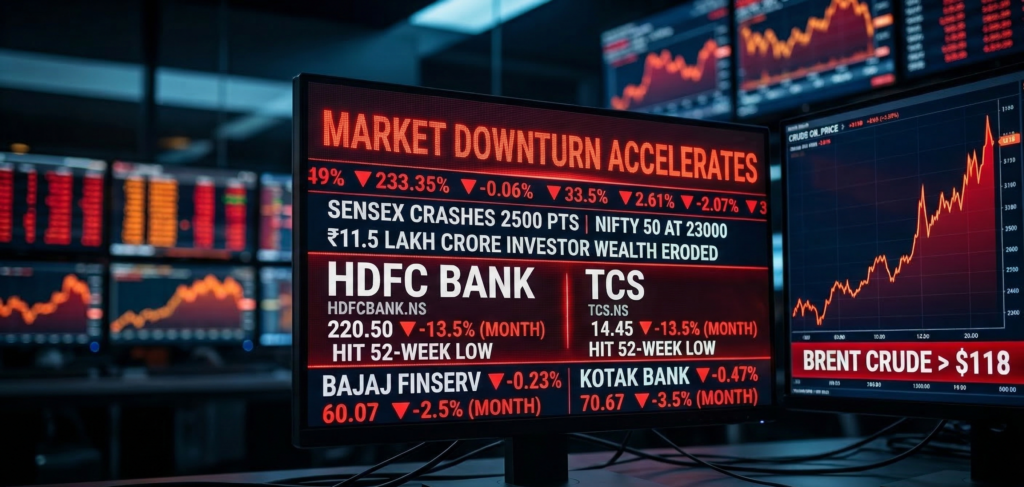
The Indian equity market witnessed one of its most turbulent sessions in recent history on Thursday, March 19, 2026. In a dramatic “risk-off” move, the BSE Sensex plummeted by nearly 2,500 points, closing at 74,207, while the Nifty 50 crashed over 770 points to settle at the psychological support level of 23,000.
The carnage was not merely a number on a screen; it represented a staggering erosion of over ₹11.5 lakh crore in investor wealth in a single day. Most notably, the “Big Boys” of the index—HDFC Bank and Tata Consultancy Services (TCS)—were among five prominent Sensex constituents that hit their 52-week lows, marking a significant sentiment shift for India’s most trusted blue-chip stocks.
The “Low” List: Five Stocks in the Eye of the Storm
While the entire market ended in the red, these five Sensex heavyweights reached their lowest price points in the last year, with some correcting as much as 16% in just 30 days.
| Stock Name | 52-Week Low (Mar 19) | Approx. 1-Month Decline | Key Triggers |
| Bajaj Finserv | ₹1,704.55 | ~16% | FII selling, hawkish Fed stance |
| Kotak Mahindra Bank | ₹363.10 | ~14% | Sectoral weakness, margin pressure |
| HDFC Bank | ₹772.00 | ~13% | Chairman resignation, FII outflows |
| TCS | ₹2,350.10 | ~13% | Global tech spend caution, AI concerns |
| ITC | ₹297.10 | ~10% | Profit booking, broader market drag |
1. HDFC Bank: A Leadership Vacuum and Institutional Exit
HDFC Bank, the bellwether of the Indian banking sector, has faced a grueling month. The stock hit a fresh 52-week low of ₹772 today. The primary catalyst for the immediate 5% intraday drop was the sudden resignation of its part-time Chairman, Atanu Chakraborty, who cited “ethical concerns” in a regulatory filing.
For an institution built on the pillars of governance and stability, such a departure is a major red flag for Foreign Institutional Investors (FIIs). Combined with the heaviest fortnightly selling by FIIs in 17 years, HDFC Bank’s price action reflects a deep “trust deficit” that technical analysts believe may take months to mend.
2. TCS: The IT Titan Hits a Global Speed Bump
Despite announcing a significant strategic partnership with Amadeus to build next-gen airline solutions, TCS shares fell 3.2% to a 52-week low of ₹2,350.10.
The irony of the situation was not lost on the market: a global deal was announced, yet the stock tanked. This highlights the current “cautious and selective” mood. Investors are no longer rewarding “potential” deals; they are demanding visibility on immediate revenue. With the US Federal Reserve signalling “higher for longer” interest rates and a hawkish outlook on inflation, the discretionary tech spend by US enterprises is expected to remain tight, directly squeezing the margins of Indian IT majors.
The Macro Forces: Why the Market is Bleeding
To understand why these giants are falling, we must look at the “Perfect Storm” of global and domestic factors currently hitting Dalal Street.
The Crude Oil Shock
Brent crude prices have surged past $110 per barrel, touching $118 in some sessions. For an oil-importing giant like India, this is the ultimate “inflation tax.” High oil prices lead to:
- Wider Current Account Deficit (CAD): Weakening the Rupee.
- Rising Input Costs: Slashing corporate profit margins across sectors like Auto, Paints, and Aviation.
The Federal Reserve’s “Hawkish” Shadow
On March 18, the US Federal Reserve kept interest rates unchanged but increased its inflation outlook. This dashed hopes of early rate cuts, leading to a spike in US bond yields. When US yields rise, FIIs typically pull money out of emerging markets like India to seek “risk-free” returns in the US, leading to the massive sell-offs we are seeing in HDFC and TCS.
The Rupee at Record Lows
The Indian Rupee hit a historic low of ₹92.89 against the US Dollar today. While a weak rupee usually benefits IT exporters, the sheer scale of FII outflows (nearly $8 billion in recent weeks) has created a liquidity crunch that has overshadowed any currency-related gains for the IT sector.
Expert Insights: Distribution or Structural Breakdown?
The sharp correction has left retail investors wondering if this is a “buying opportunity” or a “falling knife.”
Ruchit Jain, Head of Equity Technical Research at Motilal Oswal Financial Services, notes:
“The index heavyweights have witnessed a sharp sell-off due to persistent FII selling. Until external data—geopolitical news, FII flows, and Crude prices—change direction, these stocks are likely to continue underperforming.”
On the other hand, Anshul Jain of Lakshmishree Research suggests that this phase reflects a “sentiment reset” rather than a structural collapse. He points out that historically, drawdowns of 15–25% in frontline large-caps like TCS and HDFC Bank often offer favorable entry zones for long-term “buy-and-hold” investors.
What Should Investors Do Next?
Navigating a market crash requires a balance of caution and conviction. Here is a professional roadmap for the current scenario:
- Avoid Catching the “Falling Knife”: Technical indicators like the RSI (Relative Strength Index) for many of these stocks are near 28 (oversold), but in a panic market, “oversold” can stay “oversold” for a long time. Wait for a base formation before entering.
- Monitor the “Psychological Floors”: For the Nifty 50, the 22,850–23,000 zone is critical. A decisive close below 23,000 could open the doors for a further slide toward 22,500.
- Focus on Cash-Rich Companies: In high-interest-rate environments, companies with low debt and high cash reserves (like many in the IT and FMCG sectors) are better positioned to survive the volatility.
- Watch the Geopolitical Pulse: The intensifying tensions in West Asia are the primary driver of oil volatility. Any signs of de-escalation could lead to a sharp “short-covering” rally.
Conclusion
The sight of TCS and HDFC Bank at 52-week lows is a stark reminder that even the most robust portfolios are not immune to global macro shifts. While the “blood on the streets” is painful for existing holders, it serves as a reality check on valuations that had perhaps become too stretched in early 2026.
For the disciplined investor, the key is not to panic but to watch for the stabilization of the Rupee and the cooling of oil prices as the first signals of a market bottom.