
Table of Contents
HDFC Bank Governance Crisis 2026: AT1 Bond Scandal, Executive Terminations, and the Chairman’s Exit
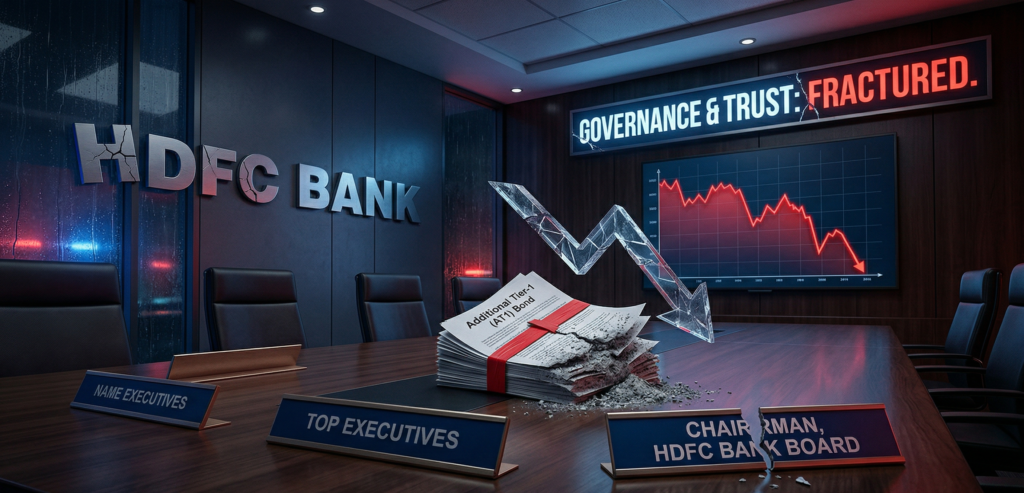
The Indian banking sector was sent into a tailspin in March 2026 as HDFC Bank, the country’s largest private-sector lender, faced a dual-pronged crisis of leadership and ethics. Within a single week, the bank witnessed the abrupt resignation of its Part-time Chairman, the termination of three top-tier executives, and a staggering ₹1.34 lakh crore ($16 billion) erosion in market capitalization.
At the heart of this turmoil is a brewing scandal involving the alleged mis-selling of Additional Tier-1 (AT1) bonds to High-Net-Worth Individuals (HNIs) and Non-Resident Indians (NRIs). This article explores the intricate details of the AT1 controversy, the high-profile exits, and what this means for the future of India’s most valuable bank.
1. The AT1 Bond Controversy: Mis-selling and Global Fallout
The crisis traces its roots to the bank’s international operations in Dubai (DIFC) and Bahrain. Internal investigations revealed a systemic failure in the sale of complex financial instruments—specifically Credit Suisse AT1 bonds.
What are AT1 Bonds?
Additional Tier-1 (AT1) bonds are perpetual debt instruments used by banks to maintain regulatory capital. While they offer higher yields (often 10% to 13%), they carry a “loss-absorbency” clause. If the issuing bank faces a financial collapse, these bonds can be written down to zero before equity is touched.
The Nature of the Allegations
The controversy erupted when NRI clients alleged that HDFC Bank employees misrepresented these high-risk bonds:
- Safety Misrepresentation: Bonds were allegedly pitched as “safe, fixed-maturity products,” comparable to traditional FCNR (Foreign Currency Non-Resident) deposits.
- Aggressive Fund Diversion: Clients were reportedly persuaded to move secure deposits from India to overseas accounts in Bahrain to fund these bond purchases.
- Lack of Disclosure: Critical risks—such as the fact that the bonds had no maturity date and could be wiped out—were allegedly omitted during the sales pitch.
- The 2023 Trigger: When Credit Suisse collapsed in 2023, its AT1 bonds worth $17 billion were written down to zero. NRI investors who purchased these through HDFC Bank lost their entire principal.
2. Termination of Top Executives: A “Clean-up” Operation
On March 20-21, 2026, HDFC Bank took the unprecedented step of terminating three of its most senior leaders. This move followed a year-long internal probe and mounting pressure from the Dubai Financial Services Authority (DFSA).
Who was Removed?
The bank’s “accountability sweep” targeted the very top of its international and branch banking hierarchy:
| Executive | Role | Significance of Removal |
| Sampath Kumar | Group Head, Branch Banking | Overseer of the entire branch network; his exit signals a major governance lapse. |
| Harsh Gupta | Executive Vice President | Head of Middle East, Africa, and NRI Onshore Business; the direct leader of the affected branches. |
| Payal Mandhyan | Senior Vice President | Held accountable for oversight lapses in client onboarding and sales practices. |
The bank stated that these terminations were “remedial actions” taken to address gaps in client onboarding and maintain internal compliance standards.
3. The Resignation of Atanu Chakraborty: An Ethical Stand?
While the AT1 bond probe was concluding, the bank suffered a second blow. On March 18, 2026, Part-time Chairman Atanu Chakraborty resigned with immediate effect.
His resignation letter contained a “poison pill” for the bank’s reputation:
“Certain happenings and practices within the bank, that I have observed over the last two years, are not in congruence with my personal values and ethics.”
Market Reaction and Governance Concerns
The phrasing of the letter—specifically the mention of “values and ethics”—triggered panic.
- Stock Crash: HDFC Bank shares plummeted nearly 9% in a single day, hitting a 52-week low.
- Valuation Wipeout: The bank’s market cap fell below 2020 pandemic levels, trading at a price-to-book (P/B) ratio of ~2.2x.
- Board Response: To stabilize the ship, the Reserve Bank of India (RBI) approved Keki Mistry (former HDFC Ltd CEO) as the interim chairman for three months.
5. Regulatory Scrutiny: RBI and DFSA Actions
The fallout has not been limited to internal firings.
- DFSA Restraint: The Dubai regulator has reportedly restricted HDFC Bank’s DIFC branch from onboarding new clients.
- RBI Monitoring: While the RBI stated there are “no material concerns on record” regarding the bank’s overall financials, it has indicated it will continue to engage closely with the board.
- Investor Lawsuits: Affected NRI clients are reportedly exploring legal options to recover the $100–$120 million lost in the AT1 bond write-down.
A table comparing the safety of traditional deposits versus the risk of AT1 bonds is a “value magnet” for readers.
Comparison: FCNR Deposits vs. AT1 Bonds
| Feature | FCNR (Fixed Deposit) | AT1 Bonds (Additional Tier-1) |
| Risk Level | Low (Bank-backed) | Very High (Equity-like risk) |
| Maturity | Fixed (1–5 years) | Perpetual (No fixed maturity) |
| Principal Safety | Guaranteed at maturity | Can be written to ZERO |
| Returns | Fixed Interest | Higher Coupon (10–13%) |
| Liquidity | Easy premature withdrawal | Hard to sell during crises |
Conclusion: A Turning Point for HDFC Bank?
The events of March 2026 mark the most significant leadership crisis since the HDFC-HDFC Bank merger. While the bank remains financially robust and well-capitalized, the “ethics storm” has bruised its image as the gold standard of Indian banking.
For investors, the key will be the findings of the external law firms and whether the bank can successfully pivot its culture from “aggressive sales” to “client suitability.”