
CANDLESTICK CHART PATTERNS IS LANGUAGE OF MARKET.
Technical Analysis · Trading Guide · 2026
Top 5 Candlestick Chart Patterns Every Trader Must Know
A deep-dive visual guide to the patterns that consistently reveal market psychology — and how to trade them with confidence.
Before charts had algorithms and before Bloomberg terminals lit up trading floors, traders studied one thing obsessively: the shape of price itself. Candlestick charting, developed by Japanese rice merchant Munehisa Homma in the 18th century, gave traders a visual language to read market psychology in real time.
Today, those same patterns — refined over three centuries of collective market observation — remain among the most reliable signals in technical analysis. Whether you trade stocks, forex, crypto, or commodities, understanding these five patterns can fundamentally change how you read a chart.
Reversal Signal Neutral
The Doji — Markets in Indecision
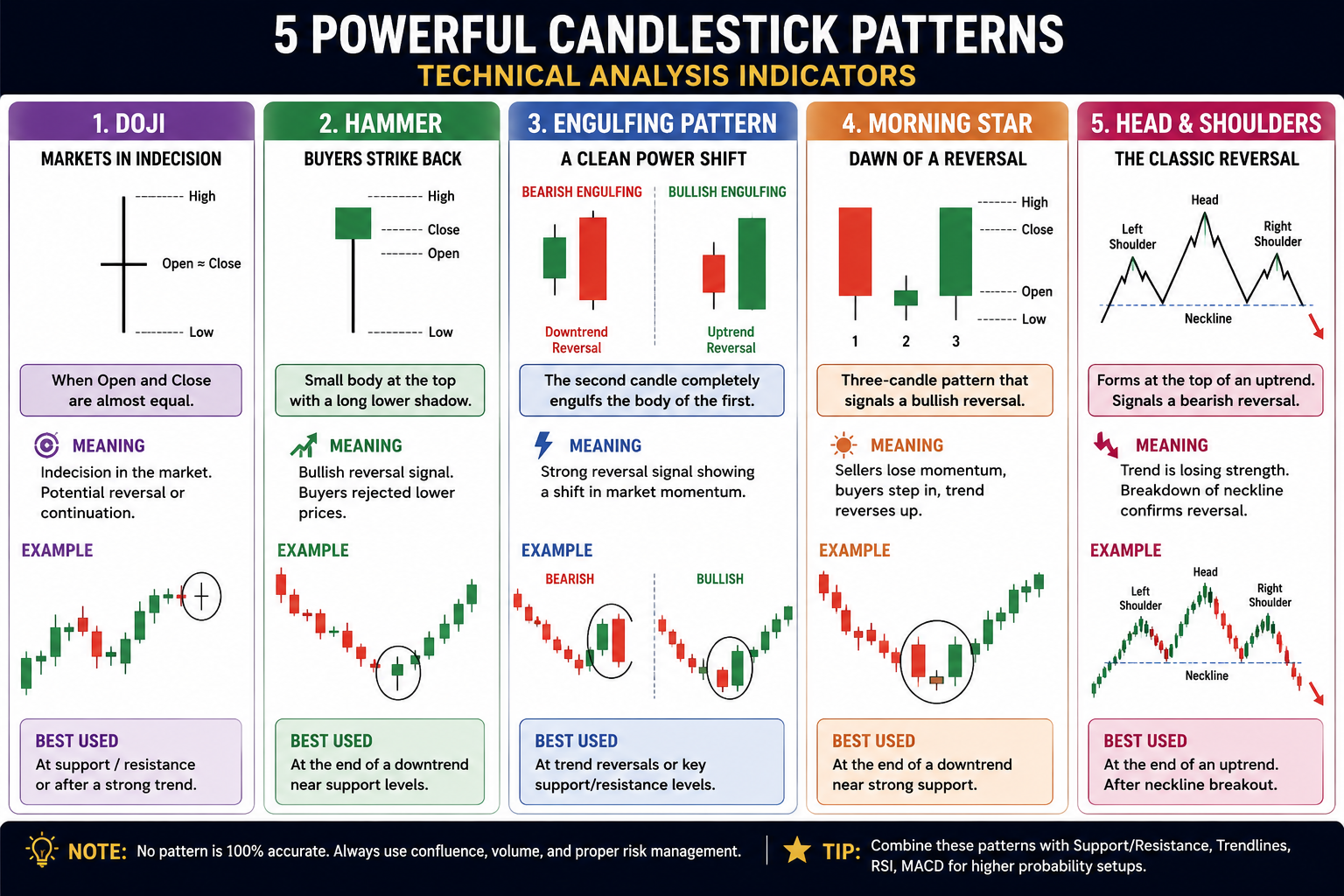
Walk up to any experienced trader and mention the word “Doji” and watch their eyes light up. Few candlestick patterns carry as much psychological weight in a single candle as this one. The Doji forms when a session’s opening and closing prices are virtually identical — leaving a candle with almost no real body, flanked by upper and lower wicks that stretch outward like wings.
What it’s telling you is simple but profound: neither bulls nor bears won that session. Every dollar of buying pressure was met with an equal dollar of selling pressure. The market is pausing, reconsidering, balanced on a knife-edge.
The Dragonfly Doji — with its long lower shadow — suggests that sellers drove price down sharply during the session, but buyers clawed it all the way back to the open. That kind of buyer conviction is often a reliable bullish reversal signal, especially at a key support level. The Gravestone Doji does the opposite, telling you buyers pushed hard, got rejected at the top, and couldn’t hold gains. At a resistance zone, that’s a warning.
Context is everything with Doji patterns. In isolation they mean little. But when they show up at the end of a prolonged move, near a major support or resistance, or confirmed by high volume — they become one of the most honest signals the market will ever give you.
Reversal Signal Bullish
The Hammer — Buyers Strike Back
Picture a battle. Sellers have been dominating for several sessions, driving price lower. Then one session, they push hard again — but this time, buyers show up with force. Price plummets during the session, but by the close, buyers have pushed it right back up near the open. The result is a small body sitting at the top of a long lower shadow — shaped exactly like a hammer driving a nail.
That long lower shadow — ideally twice the height of the body — is the key. It’s physical evidence that sellers tried and failed. The buyers absorbed every ounce of selling pressure and reclaimed the high ground. When this pattern appears after a downtrend, near a support level, it’s one of the cleanest bullish reversal signals in technical analysis.
Now flip the context entirely. Put that same shape — same small body, same long lower shadow — at the top of a confirmed uptrend. Suddenly it becomes a Hanging Man, and the interpretation reverses entirely. Here, the pattern is saying something unsettling: even in an uptrend, sellers were able to push price down significantly during the session. Buyers recovered, yes — but should we be worried about tomorrow?
The answer depends on what follows. Both patterns require confirmation from the next candle. A hammer followed by a strong bullish candle is a legitimate entry signal. A Hanging Man followed by a bearish candle closing below its low is a serious warning to reduce long exposure.
Reversal Signal Bullish Bearish
The Engulfing Pattern — A Clean Power Shift
If the Doji is a question mark, the Engulfing pattern is an exclamation point. This two-candle formation leaves absolutely no ambiguity about who just seized control of the market. In a Bullish Engulfing, a small bearish candle is completely swallowed — “engulfed” — by the body of the following bullish candle. The larger body completely overpowers the prior session’s price range.
Think about what that means in market terms. Yesterday’s sellers pushed price down all day. Today, buyers not only recovered every penny of that loss — they surpassed it, closing significantly above yesterday’s open. That’s not just a reversal; it’s a statement of intent. Sentiment has genuinely shifted.
The Bearish Engulfing is its mirror — a large bearish candle swallowing a small bullish candle at the top of an uptrend. The sellers didn’t just erase yesterday’s gains; they went well beyond it. After this pattern, it’s not uncommon to see a sharp reversal in the sessions that follow.
Both varieties work best when they appear at structurally important price levels — major support, resistance, a prior swing high or low. Volume is a significant confirmation factor; an engulfing candle with above-average volume is substantially more reliable than one with thin volume. Experienced traders often look for this pattern on the weekly chart to identify major trend reversals with enough momentum to carry weeks-long moves.
Reversal Signal Bullish
The Morning Star — Dawn of a New Trend
If there’s a pattern that reads like poetry in chart form, it’s the Morning Star. This elegant three-candle formation tells the story of a market that was falling, paused in exhaustion, then ignited — all in three sessions. The name is entirely intentional: just as the morning star appears in the sky before the sun rises, this pattern signals the arrival of a new bullish dawn.
Here’s how it unfolds. Session one delivers a large bearish candle — the bears are firmly in control, price has been falling. Session two opens with a downward gap and produces a small-bodied candle, either bull or bear. The small body is crucial: it tells you the bears are losing steam. They couldn’t sustain the momentum. Session three then opens higher, gaps up if you’re lucky, and closes strongly bullish — pushing well above the midpoint of that first big bearish candle.
The Evening Star is its bearish counterpart — three candles that play out the same drama in reverse at the top of an uptrend. A large bullish candle gives way to a hesitant star candle, followed by a decisive bearish candle that slashes back deep into the first candle’s gains.
What makes Morning and Evening Stars so powerful is their narrative completeness. You’re not reading one moment in time — you’re watching a three-act story of a trend exhausting itself and a new one beginning. On the daily chart, this pattern is particularly reliable in trending markets and is frequently cited by swing traders as one of their preferred entry triggers.
Reversal Signal Bearish
Head & Shoulders — The Classic Reversal King
Of all the patterns in technical analysis, the Head and Shoulders is arguably the most celebrated — and the most feared by those holding long positions. It’s a multi-swing reversal pattern that literally looks like a person’s silhouette: a left shoulder, a taller head in the middle, and a right shoulder approximately equal in height to the left. It forms over weeks or even months, which is precisely why it carries such predictive weight.
Here’s the narrative embedded in those price swings. During an uptrend, price rallies to form the left shoulder, then pulls back. The bulls rally again more powerfully — forming the head — but then struggle to hold the gains and pull back to roughly the same level as before. They try one more time, but this third rally fails at roughly the same height as the left shoulder. The market has attempted three times to push higher and has failed. The right shoulder’s inability to match the head’s height is a damning statement about the bulls’ deteriorating control.
Volume patterns within the formation add crucial weight to the signal. Typically, volume is highest on the left shoulder rally, lower on the head rally, and lower still on the right shoulder — a clear pattern of declining buying enthusiasm. Then, when the neckline breaks, volume often surges again as sellers pile in and stop-losses are triggered beneath that key level.
The Inverse Head and Shoulders — the same pattern flipped upside down — appears at market bottoms and signals bullish reversals. It’s one of the highest-conviction patterns in the entire technical analysis toolkit. Many veteran traders will only trade this pattern on the daily or weekly chart, where the “noise” of shorter timeframes can’t distort the structure.
Patterns Are a Language — Learn to Read It
Candlestick patterns don’t predict the future. What they do is give you a probabilistic edge — a systematic way of reading the crowd psychology embedded in price action, refined by centuries of collective market experience.
The traders who consistently profit from these patterns share one trait: patience. They wait for the right context — a strong prior trend, a key price level, confirming volume — before acting. They treat each pattern as one piece of evidence, not a guaranteed outcome.
Start by mastering one pattern. Watch it form in real-time across multiple assets and timeframes. Keep a trading journal. Note when it worked, when it failed, and why. That discipline, over time, is what transforms a pattern recognizer into a skilled trader.