
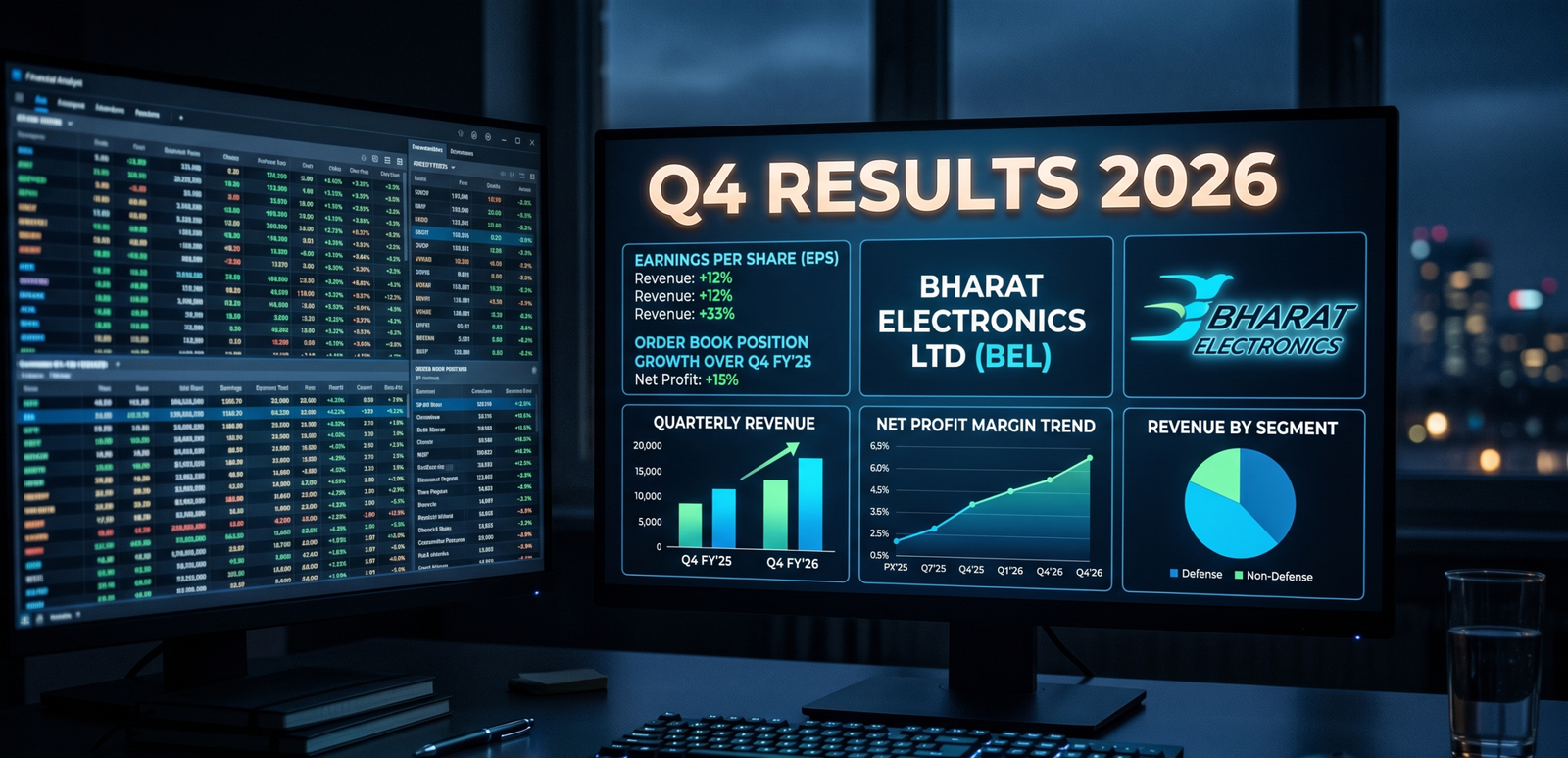
BEL Q4 RESULTS DETAILED ANALYSIS.
Bharat Electronics Delivers a Record Year — Revenue Crosses ₹27,479 Crore, PAT Up 14.38%
India’s premier Navratna defence PSU closes FY26 with double-digit growth across every key metric, a ₹73,882 crore order book, and a final dividend for shareholders.
Introduction: BEL’s Landmark Year
If there’s one company that has quietly mirrored the rise of India’s defence ambitions over the past decade, it is Bharat Electronics Limited (BEL). On 19 May 2026, the Bengaluru-headquartered Navratna PSU filed its Board Meeting outcome with both BSE (Scrip Code: 500049) and NSE (Symbol: BEL), unveiling financial results that would make even the most seasoned defence analyst sit up straight.
The headline numbers were hard to ignore. Revenue from operations crossed ₹27,479 crore for FY2025-26 — a 16.15% jump over the previous year’s ₹23,658 crore. Profit After Tax climbed to ₹6,048.48 crore, growing 14.38% year-on-year. These aren’t just numbers; they reflect a company operating at a structural inflection point.
The results were reviewed by the Audit Committee at its meeting on 18 May 2026 and formally approved by the Board of Directors the following day — 19 May 2026 — at a meeting that commenced at 11:15 AM and concluded at 3:00 PM in Dharamshala. Statutory auditors Rao & Emmar, Chartered Accountants, issued their report with an unmodified (clean) opinion — a signal of clean books and transparent accounting.
In this article, we dissect every layer of BEL’s FY26 results — quarter by quarter, standalone versus consolidated, balance sheet to cash flow — and attempt to put this performance in the larger context of India’s defence modernisation journey.
Q4 FY26 Snapshot — Quarter at a Glance
The fourth quarter (January–March 2026) is typically BEL’s strongest, given the defence procurement cycle in India tends to peak towards fiscal year-end. FY26 was no exception.
Q4 FY26 standalone revenue came in at ₹10,177.17 crore versus ₹9,119.71 crore in Q4 FY25 — an increase of roughly 11.6%. Q4 PAT grew more modestly, from ₹2,104.78 crore to ₹2,203.16 crore, a 4.7% increase. Profit Before Tax improved from ₹2,847.62 crore to ₹2,903.82 crore.
One nuance worth flagging: as per Note 12 in the financial results, Q4 figures are derived (balancing) figures — arrived at by subtracting nine-month figures from the full-year audited numbers. This is standard practice under SEBI’s Listing Regulations and doesn’t diminish the reliability of the full-year numbers, which are fully audited.
Full Year FY26 Financial Performance
The full-year numbers tell an even more compelling story. Below is the complete standalone Profit & Loss picture for FY2025-26 versus FY2024-25.
| Particulars | FY26 (₹ Lakhs) | FY25 (₹ Lakhs) | YoY Change |
|---|---|---|---|
| Revenue from Operations | 27,47,963 | 23,65,801 | +16.15% |
| Other Income | 59,039 | 76,759 | -23.08% |
| Total Income | 28,07,002 | 24,42,560 | +14.92% |
| Cost of Materials Consumed | 13,80,564 | 12,56,140 | +9.91% |
| Employee Benefits Expense | 3,09,091 | 2,73,436 | +13.04% |
| Depreciation & Amortisation | 52,393 | 43,558 | +20.28% |
| Other Expenses | 2,39,410 | 1,97,508 | +21.21% |
| Total Expenses | 19,99,498 | 17,33,561 | +15.33% |
| Profit Before Tax (PBT) | 8,07,504 | 7,08,999 | +13.89% |
| Total Tax Provision | 2,02,656 | 1,80,174 | +12.48% |
| Profit After Tax (PAT) | 6,04,848 | 5,28,825 | +14.38% |
| Total Comprehensive Income | 6,08,317 | 5,29,653 | +14.86% |
| EPS (Basic & Diluted) | ₹8.27 | ₹7.23 | +14.38% |
Revenue Analysis: What Drove the 16% Surge?
BEL’s revenue growth to ₹27,479.63 crore did not happen in a vacuum. It is the product of several converging forces — India’s accelerating defence modernisation, the government’s indigenisation push under Aatmanirbhar Bharat, and BEL’s own execution capability built over decades.
Defence electronics is a segment where order wins today translate into revenues over a 3-5 year horizon. BEL’s consistent order inflows in prior years — spanning radar systems, electronic warfare suites, communication equipment, avionics, and naval systems — are now maturing into revenue. The company’s order book of ₹73,882 crore as on 1 April 2026 (approximately 2.7x its FY26 revenue) provides very strong revenue visibility.
On the cost side, materials consumed rose to ₹13,80,564 lakhs (FY25: ₹12,56,140 lakhs), growing roughly in line with revenue — a sign of healthy operating leverage. Employee costs increased 13%, which is expected given salary revisions in PSUs, but remained well-controlled as a percentage of revenue.
Other income fell from ₹76,759 lakhs in FY25 to ₹59,039 lakhs in FY26 — a decline of about 23%. This is not alarming; other income in large PSUs often includes interest on fixed deposits, dividend receipts, and gains on investments, which can vary year to year. BEL’s core operating income more than compensated.
Profitability Deep Dive — PBT, PAT and Margins
Profit Before Tax for FY26 stood at ₹8,075.04 crore, up 13.89% from ₹7,089.99 crore. After accounting for tax provisions of ₹2,026.56 crore (effective tax rate of approximately 25.1%), Profit After Tax landed at ₹6,048.48 crore.
A quick back-of-envelope margin calculation is instructive. Standalone PBT margin for FY26 works out to approximately 29.4% (₹8,075 Cr / ₹27,480 Cr), versus 30.0% in FY25. And PAT margin stands at approximately 22.0% for FY26 versus 22.4% for FY25. These are marginal compressions — largely attributable to the increase in other expenses (+21%) and depreciation (+20%) — but nothing structurally concerning.
Earnings Per Share (EPS) grew from ₹7.23 to ₹8.27 on a fully paid-up equity share capital of ₹73,098 lakhs (73.1 crore shares of ₹1 each). The EPS improvement of 14.4% directly tracks PAT growth, confirming no dilutive capital events during the year.
Balance Sheet Highlights
BEL’s standalone balance sheet as on 31 March 2026 reflects a company in robust financial health, with total assets growing from ₹40,418 crore in FY25 to ₹44,090 crore in FY26.
| Balance Sheet Item | 31 Mar 2026 (₹ Lakhs) | 31 Mar 2025 (₹ Lakhs) |
|---|---|---|
| Total Assets | 44,09,039 | 40,41,808 |
| Non-Current Assets | 6,31,699 | 5,79,091 |
| Current Assets | 37,77,340 | 34,62,717 |
| Inventories (Current) | 10,09,419 | 9,06,966 |
| Trade Receivables | 12,84,528 | 9,09,196 |
| Cash & Cash Equivalents | 1,82,693 | 68,168 |
| Bank Balances (Other) | 6,59,174 | 8,71,562 |
| Total Equity | 23,69,756 | 19,69,768 |
| Non-Current Liabilities | 1,21,739 | 1,02,189 |
| Current Liabilities | 19,17,544 | 19,69,851 |
| Borrowings (Current + NCL) | Nil | Nil |
A few highlights stand out. First, BEL remains completely debt-free — there are zero borrowings on both the current and non-current liabilities side. This is a rare distinction in heavy industry and is a testament to the company’s consistent cash generation.
Second, cash and cash equivalents surged dramatically from ₹68,168 lakhs to ₹1,82,693 lakhs — more than a 2.5x jump. The standalone cash flow statement explains this: net cash from operating activities improved sharply to ₹1,49,434 lakhs (vs ₹45,725 lakhs in FY25), driven by better working capital management and higher profitability.
Third, trade receivables also expanded — from ₹9,09,196 lakhs to ₹12,84,528 lakhs. This increase of ~41% is proportionally higher than revenue growth and bears watching. In a defence PSU context, receivables tied to government orders carry very low credit risk, but elevated levels can create temporary liquidity pressure.
Total equity crossed ₹23,697 crore in FY26, up from ₹19,698 crore — a reflection of retained earnings building steadily on BEL’s books.
Dividend Announcement & Total Payout
Income investors will note that BEL has maintained a consistent and growing dividend track record. For FY2025-26, the company’s total dividend distribution is structured as follows:
Final Dividend Recommended — FY 2025–26
Subject to shareholder approval at the ensuing Annual General Meeting. The record date and payment timeline will be announced separately.
| Dividend Type | Amount per Share | When Paid/Recommended | Approx Total Payout |
|---|---|---|---|
| Interim Dividend | ₹1.95 | March 2026 | ~₹1,425 Cr |
| Final Dividend (Recommended) | ₹0.55 | Subject to AGM approval | ~₹402 Cr |
| Total FY26 Dividend | ₹2.50 per share | — | ~₹1,827 Cr |
With 73.1 crore equity shares outstanding, the total dividend outflow for FY26 — including the interim dividend already paid in March 2026 and the recommended final dividend — adds up to approximately ₹1,827 crore. That is approximately 30% of PAT being returned to shareholders, which reflects a healthy payout policy without being so aggressive as to constrain reinvestment capacity.
The cash flow statement corroborates this: dividends paid in FY26 amounted to ₹2,08,252 lakhs (roughly ₹2,083 crore), which likely includes the prior year’s final dividend paid in FY26 and the FY26 interim dividend, consistent with normal timing conventions.
Order Book — The Pipeline That Matters Most
For a company like BEL, the order book is the most forward-looking metric. As on 1 April 2026, BEL’s order book stood at ₹73,882 crore — an extraordinary number that represents approximately 2.7 years of FY26 revenue.
This order book acts as a powerful earnings visibility cushion. Assuming BEL continues to add fresh orders — as it has consistently over the past three years — the revenue trajectory for FY27 and FY28 appears well supported. Importantly, the order backlog covers a diversified mix of platforms: radar systems, electronic warfare, communication, avionics, naval systems, homeland security, and space electronics.
The note in BEL’s financials regarding Israel-related contracts is worth flagging: the company assessed ongoing geopolitical conflicts in Israel and concluded there is no material financial impact on its contracts/agreements with Israeli companies as of the date of results. This is a prudent and transparent disclosure, given BEL’s partnerships with Israeli defence firms in areas like radar and missile systems.
Consolidated vs Standalone: What’s the Difference?
BEL’s consolidated results include two subsidiaries — BEL Optronic Devices Limited (BELOP, 100% owned) and BEL Thales Systems Limited (74% owned) — as well as two associates: GE-BE Private Limited (26% stake) and BEL IAI AeroSystems Private Limited (40% stake).
The difference between consolidated and standalone is minimal — roughly ₹130 crore in additional revenue and ₹14 crore in extra PAT — reflecting the fact that BEL’s subsidiaries are relatively small in scale compared to the parent. BELOP, the optronic devices subsidiary, had revenue of approximately ₹270 crore and a modest total comprehensive income of ₹7.77 crore for FY26. BEL Thales Systems had the remainder.
The share of net profit from associates (accounted via equity method) contributed a consolidated ₹38.79 crore (FY25: ₹35.53 crore), with GE-BE Private Limited contributing positively (~₹40 crore PAT for BEL’s share) while BEL IAI AeroSystems recorded a marginal loss (BEL’s share: ~₹0.69 crore).
Key Risks and Auditor Notes
Rao & Emmar, Chartered Accountants issued clean (unmodified) opinions on both standalone and consolidated financial results. However, several disclosures in the “Other Matters” section are worth investor attention.
Board Composition: As on 31 March 2026, BEL’s Board comprises 7 whole-time executive directors (including the CMD), 2 part-time government non-executive directors, and only 3 independent directors. SEBI’s Listing Regulations and the Companies Act 2013 mandate a higher proportion of independent directors. There are six vacancies of independent directors (including one independent woman director) yet to be filled by the Ministry of Defence. The vacancies have been notified to the government, but non-compliance with governance norms is something investors should track. The auditors noted this without modifying their opinion.
Labour Codes Impact: The Government of India notified the Code on Wages 2019, Industrial Relations Code 2020, Code on Social Security 2020, and Occupational Safety Code 2020 on 21 November 2025. BEL assessed the financial impact and found an increase in Gratuity and Provident Fund liability of ₹2,055 lakhs (₹20.55 crore). This is relatively modest but the company will continue monitoring developments.
Israel Operations: BEL has contracts/agreements with companies based in Israel. Given ongoing geopolitical conflict, the company assessed the situation and found no material financial impact as of the date of results. This will require ongoing monitoring, particularly for joint venture activities in radar and defence electronics.
Supplementary CAG Audit: As is mandatory for a government company, the FY26 results are subject to supplementary audit by the Comptroller & Auditor General of India under Section 143(6) of the Companies Act, 2013. This is standard practice and not a concern.
Outlook & Investor Perspective
Looking ahead to FY2026-27 and beyond, BEL’s structural growth drivers appear firmly intact. India’s defence budget has been on a sustained upward trajectory. The government’s push for indigenisation — specifically the positive indigenisation lists that reserve procurement for domestic manufacturers — directly benefits BEL as the country’s dominant electronics defence PSU.
An order book of ₹73,882 crore is not just comfort — it is a near-guarantee of sustained revenue growth. Historically, defence PSUs execute roughly 30-35% of their order book per year. If BEL executes even at 33%, that implies FY27 revenue of over ₹24,000 crore from the existing order book alone, before counting new orders. With fresh order wins expected to supplement, the revenue run-rate of ₹30,000+ crore in the next two years is a reasonable aspiration.
Margin discipline will be a key watch. The slight compression in FY26 PBT margins (from 30% to ~29.4%) bears watching if it continues. Higher employee costs from labour code compliance, rising other expenses, and accelerating depreciation from capital investment are manageable headwinds.
The cash flow profile is becoming more robust. Operating cash flow jumped from ₹45,725 lakhs in FY25 to ₹1,49,434 lakhs in FY26 — a remarkable recovery that reflects better collections (relative to prior year). However, trade receivables growing 41% YoY is a counterweight to watch — if government payments slow, working capital pressure could build.
For income-focused investors, the ₹2.50 total dividend (₹1.95 interim + ₹0.55 final recommended) represents a continued commitment to shareholder returns. The dividend payout ratio of ~30% leaves ample room for reinvestment in capacity expansion and R&D — which is essential for sustaining technological edge in a rapidly evolving defence landscape.
Conclusion
Bharat Electronics Limited’s FY2025-26 results are, by any objective measure, outstanding. Revenue grew 16.15%, PAT grew 14.38%, the company remains entirely debt-free, and the order book sits at a record ₹73,882 crore. The statutory auditors gave a clean bill of health. The final dividend of ₹0.55 per share (on top of the ₹1.95 interim already paid) underlines management’s confidence in the business.
Challenges exist — the ongoing gap in board composition with respect to independent directors, rising other expenses, and the trade receivables build-up are genuine items to monitor. But these are manageable concerns against the backdrop of a business that is executing very well on its core mandate.
BEL is no longer just a PSU that benefits from captive government orders. Over the last five years, it has evolved into a sophisticated, multi-product defence electronics company with credible technological capabilities and an increasingly diversified product portfolio. That evolution is now visible in the financial numbers — and if the order book trajectory holds, the next few years could be even stronger.
This article is based entirely on BEL’s publicly filed financial results and Board Meeting outcome dated 19 May 2026, filed with BSE (F. No. 17565/4/SE/MUMC/SEC) and NSE (F. No. 17565/6/SE/NSEC/SEC).