
Table of Contents
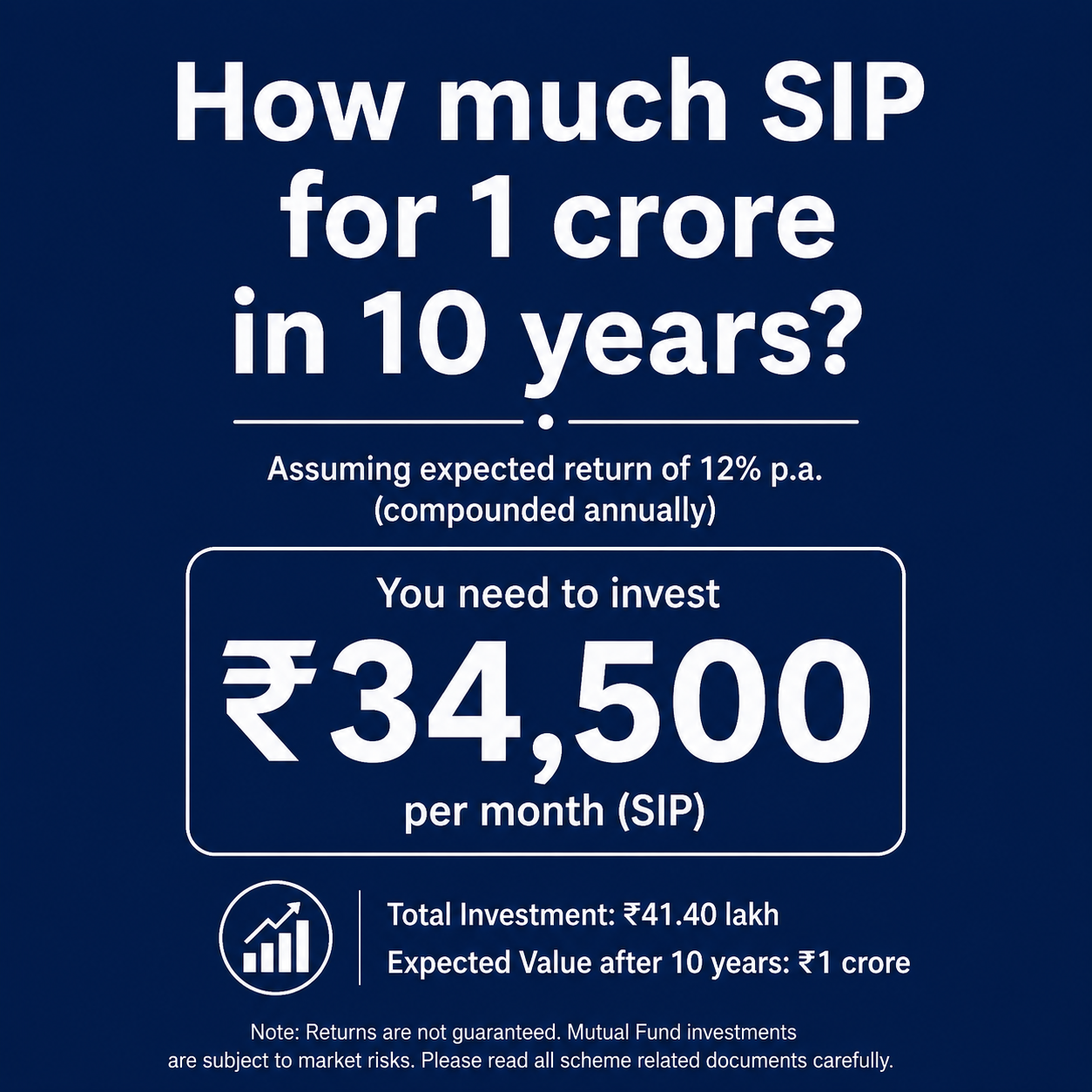
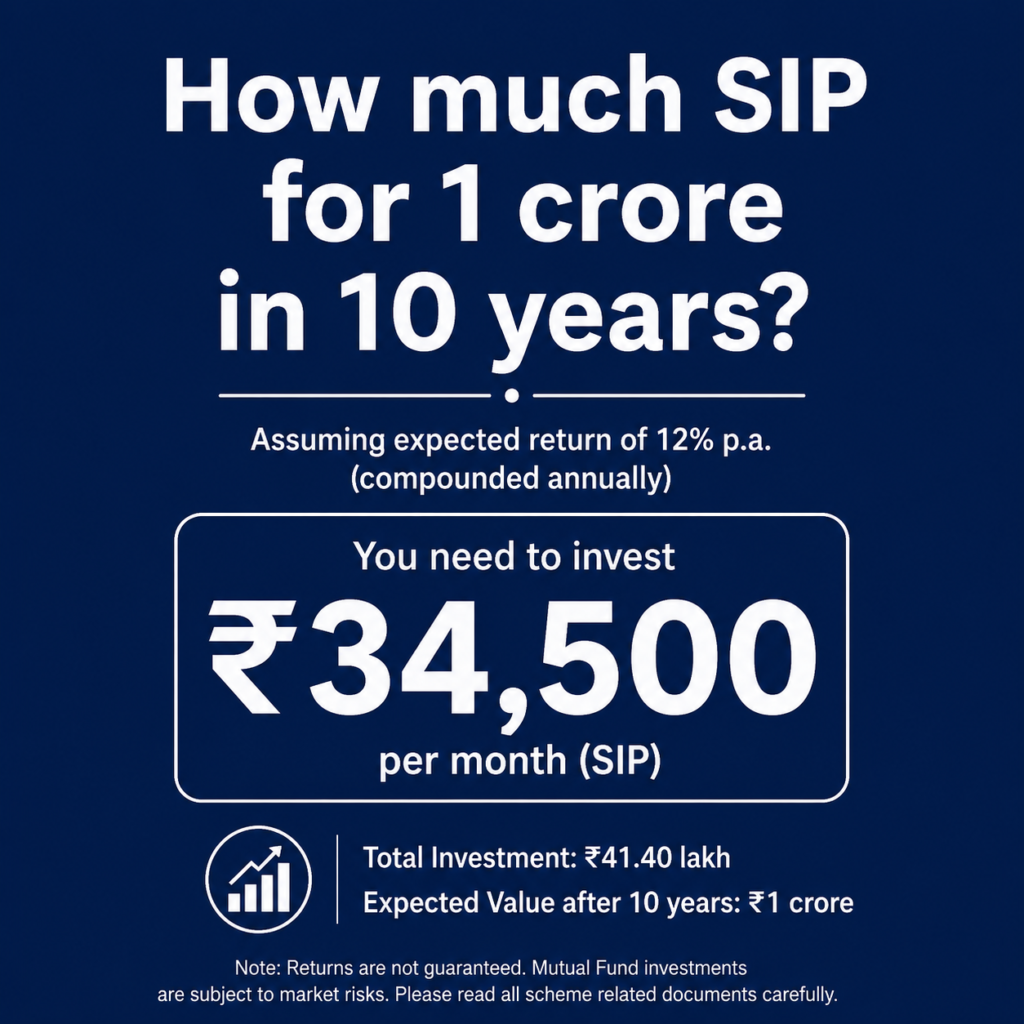
How much Sip for 1 crore in 10 years — Amassing a corpus of ₹1 Crore (10 million) is a major financial milestone. Whether your goal is early retirement, funding your child’s higher education abroad, or building a robust safety net, achieving this target within a 10-year timeframe is entirely possible.
However, because 10 years is considered a medium- to long-term horizon in the financial world, you cannot rely on luck. You need a disciplined, calculated approach. This is where a Systematic Investment Plan (SIP) via mutual funds becomes your most powerful ally.
In this comprehensive guide, we will break down exactly how much you need to invest monthly to hit the ₹1 Crore mark in 10 years, how different expected rates of return alter your investment amount, and the smart strategies you can use to reduce your monthly burden.
The Core Math: How Much SIP is Needed for ₹1 Crore?
The exact monthly SIP amount required to reach ₹1 Crore depends almost entirely on the Compounded Annual Growth Rate (CAGR) your investment portfolio generates.
Because mutual funds market returns fluctuate, it is wise to analyze three different scenarios: Conservative (10%), Moderate (12%), and Aggressive (15%).
Using the standard future value formula for an annuity:
$$FV = P \times \frac{(1 + r)^n – 1}{r} \times (1 + r)$$
(Where $FV$ is the Future Value, $P$ is the monthly SIP, $r$ is the monthly interest rate, and $n$ is the total number of months), here is how the numbers stack up for a 10-year (120 months) horizon:
1. The Moderate Scenario (12% Expected Return)
Historically, diversified Indian equity mutual funds have delivered returns in the range of 12% over a decade.
- Monthly SIP Required: ₹43,041
- Total Amount Invested: ₹51,64,920
- Wealth Gained (Interest): ₹48,35,080
2. The Aggressive Scenario (15% Expected Return)
If you tilt your portfolio toward high-growth segments like mid-cap, small-cap, or sectoral funds, you might aim for a 15% return, though it comes with significantly higher volatility.
- Monthly SIP Required: ₹36,159
- Total Amount Invested: ₹43,39,080
- Wealth Gained (Interest): ₹56,60,920
3. The Conservative Scenario (10% Expected Return)
If you prefer a balanced or hybrid approach (mixing equity with debt to protect against market downturns), a 10% return is a realistic benchmark.
- Monthly SIP Required: ₹48,414
- Total Amount Invested: ₹58,09,680
- Wealth Gained (Interest): ₹41,90,320
Quick Comparison Table
| Expected Annual Return (%) | Monthly SIP Amount Required | Total Invested over 10 Years | Wealth Earned via Compounding |
| 10% (Conservative) | ₹48,414 | ₹58,09,680 | ₹41,90,320 |
| 12% (Moderate) | ₹43,041 | ₹51,64,920 | ₹48,35,080 |
| 15% (Aggressive) | ₹36,159 | ₹43,39,080 | ₹56,60,920 |
The “Step-Up SIP” Secret: How to Lower Your Starting Investment
Looking at a monthly SIP of ₹43,000+ might feel intimidating if you are early in your career or have existing financial obligations. Fortunately, you don’t have to start with that full amount.
As your salary, business revenue, or freelance income grows over time, your investments should too. This strategy is known as a Step-Up SIP or a Top-Up SIP. By increasing your monthly investment by a fixed percentage every year, you can start much smaller and still cross the ₹1 Crore finish line.
Let’s look at how a 10% annual Step-Up reduces your starting monthly investment, assuming a realistic 12% annual return:
- Year 1 Starting SIP: ₹26,900 per month
- Year 2 SIP (with 10% increase): ₹29,590 per month
- Year 3 SIP: ₹32,549 per month
- …continuing this cycle…
- Year 10 SIP: ₹57,820 per month
The Result: By starting with just ₹26,900 instead of ₹43,041, you comfortably hit your ₹1 Crore target in 10 years. This aligns your financial goals beautifully with your career progression.
How Long-Term Capital Gains (LTCG) Tax Impacts Your Corpus
When calculating how much SIP for 1 crore in 10 years is required, many investors make the critical mistake of ignoring taxes. Your actual in-hand corpus will be slightly lower due to Long-Term Capital Gains (LTCG) Tax.
In India, if you hold equity mutual fund units for more than 12 months, the profits are classified as long-term capital gains.
- LTCG on equity mutual funds is exempt up to ₹1.25 Lakh per financial year.
- Any gains above ₹1.25 Lakh are taxed at 12.5% (without indexation benefits).
Adjusting for Taxes
If you target a gross corpus of ₹1 Crore, your net post-tax amount might hover around ₹94 Lakhs to ₹96 Lakhs depending on your exact investment gains. To ensure you have a clean net ₹1 Crore in your bank account, it is highly recommended to pad your target by roughly 4% to 5%.
Aiming for a gross target of ₹1.05 Crores ensures that your post-tax corpus remains safely above the ₹1 Crore threshold.
Designing the Ideal Portfolio to Hit ₹1 Crore in 10 Years
A 10-year timeline gives you enough leeway to absorb short-term stock market corrections, making a heavily equity-oriented asset allocation the ideal choice. Here is a blueprint for a balanced, high-performing mutual fund portfolio tailored for this goal:
1. Large-Cap / Index Funds (Allocation: 30% – 40%)
- Purpose: These funds invest in India’s top 100 companies (like Reliance, HDFC Bank, and TCS). They provide stability, consistent performance, and act as an anchor during market crashes.
- Expected Return: 11% – 13%
2. Flexi-Cap / Large & Mid-Cap Funds (Allocation: 30%)
- Purpose: Fund managers of flexi-cap funds have the freedom to shift money between large, mid, and small-cap companies based on market conditions. This dynamic allocation maximizes opportunities while minimizing risk.
- Expected Return: 12% – 14%
3. Mid-Cap & Small-Cap Funds (Allocation: 20% – 30%)
- Purpose: Mid and small-sized companies have exponential growth potential. While volatile in the short run, they historically outperform large caps over a 10-year horizon.
- Expected Return: 14% – 16%
4. International or Sectoral Funds (Optional Allocation: 10%)
- Purpose: Provides geographical diversification (e.g., investing in US tech stocks) or allows you to capitalize on roaring domestic sectors like infrastructure, banking, or technology.
Golden Rules for Ensuring You Hit Your ₹1 Crore Goal
Simply starting an SIP isn’t enough; maintaining it through market cycles is what guarantees success. Follow these principles to protect your investment plan:
Automate Your Investments
Set up an auto-debit facility from your bank account for a date immediately following your salary or income credit. Treating your SIP like a mandatory bill ensures you invest first and spend what is left, rather than investing what is left after spending.
Never Panic-Pause During Market Downturns
When the stock market crashes, it is natural to feel anxious. However, a falling market is actually an SIP investor’s best friend. Through a mechanism called Rupee Cost Averaging, your fixed monthly SIP buys more mutual fund units when prices are low. When the market recovers, these extra units accelerate your journey to ₹1 Crore.
Review and Rebalance Annually
Check your portfolio performance once a year. If a specific fund is consistently underperforming its benchmark index for more than 4 to 6 consecutive quarters, do not hesitate to switch your future SIPs to a healthier fund.
Avoid the Temptation to Withdraw Early
As your portfolio grows to ₹30 Lakhs, ₹50 Lakhs, or ₹70 Lakhs, you will face the temptation to dip into it for luxury purchases, cars, or vacations. Remind yourself of your primary goal. Compounding does its heaviest lifting in the final 3 years of a 10-year cycle; breaking the chain early drastically deflates your ultimate corpus.
Summary: Your Action Plan to ₹1 Crore
To recap your strategy based on your financial capacity today:
- If you have a high stable income: Start a fixed monthly SIP of ₹43,041 in a curated mix of equity mutual funds.
- If you want to scale up gradually: Start with a Step-Up SIP of ₹26,900 per month and increase your contribution by 10% every single year.
- Choose the right mix: Allocate roughly 70% to stable large/flexi-cap funds and 30% to high-growth mid/small-cap funds.
- Factor in taxes: Aim for a total target of ₹1.05 Crores so you walk away with a clean ₹1 Crore after paying your 12.5% LTCG tax.
The most critical factor in wealth creation isn’t finding the perfect fund—it is the time you give your money to grow. Start your SIP today, stay disciplined through market highs and lows, and watch compounding transform your monthly savings into a life-changing financial cushion.
Frequently Asked Questions (FAQs)
Can I get a guaranteed ₹1 Crore return from a mutual fund SIP?
No. Mutual fund investments are subject to market risks. Unlike fixed deposits, returns are not guaranteed. However, historical data over 10-year periods shows that diversified equity funds consistently outperform traditional savings instruments and comfortably beat inflation.
What happens if my mutual fund returns drop to 8%?
If your average return drops to 8%, your corpus at the end of 10 years with a ₹43,041 monthly SIP will be roughly ₹79 Lakhs. To counter this risk, monitor your portfolio annually and adjust your monthly investments upward if returns lag.
Is a 10-year horizon enough for small-cap mutual funds?
Yes, a 10-year horizon is generally considered adequate for small-cap funds to ride out economic cycles and deliver high returns. However, you should transition your small-cap allocations into safer large-cap or liquid funds during the 9th and 10th years to shield your final corpus from sudden market crashes right before maturity.
Disclaimer & Risk Warning
The calculations, projections, and figures mentioned in this article are for illustrative and educational purposes only. They are based on assumed rates of return and do not guarantee future performance or specific final outcomes. Mutual fund investments are strictly subject to market risks; please read all scheme-related documents carefully before investing. Past performance is not an indicator of future results. This content does not constitute professional financial, investment, or legal advice. It is highly recommended that you consult a certified financial planner (CFP) or SEBI-registered investment advisor before making any major financial decisions.