HUL gets Rs 1,559 crore income tax demand for FY22, says no impact on business

Read detailed news of HUL on Money control
Hindustan Unilever Limited (HUL), India’s largest fast-moving consumer goods (FMCG) company, has received an income tax demand of ₹1,559 crore for the financial year 2021–22 (FY22), according to a regulatory filing made by the company. The demand was raised by the Income Tax Department following the completion of assessment proceedings, drawing immediate attention from investors and market participants. However, HUL has moved swiftly to reassure stakeholders, stating that the order will have no material impact on its financial position, operations, or business continuity, underlining the company’s strong balance sheet and robust compliance framework.

In its official communication, HUL clarified that the tax demand primarily arises from matters related to disallowances and additions made by the assessing officer, many of which have been disputed by the company in previous years as well. The FMCG major emphasized that it firmly believes the demand is not tenable on merit, and that similar issues have been decided in its favor by appellate authorities in the past. As a result, the company plans to challenge the order before the appropriate legal forums within the prescribed timelines, while also seeking a stay on the demand.

Despite the sizeable headline figure of ₹1,559 crore, HUL has categorically stated that there will be no adverse impact on its business operations or financial health. The company’s strong cash flows, low debt levels, and consistent profitability provide it with ample financial resilience to manage such contingencies. For investors, this assurance is significant, as it reinforces confidence in HUL’s ability to navigate regulatory and legal challenges without disrupting its core business performance.

Market experts note that large tax demands are not uncommon for corporations of HUL’s scale, particularly given the complexity of tax laws and the interpretational differences that often arise during assessments. Such matters typically go through multiple stages of appeal and litigation, often spanning several years. In many cases, the final liability, if any, turns out to be substantially lower than the initial demand. HUL’s long history of successfully contesting similar cases further supports the company’s confidence in a favorable outcome.

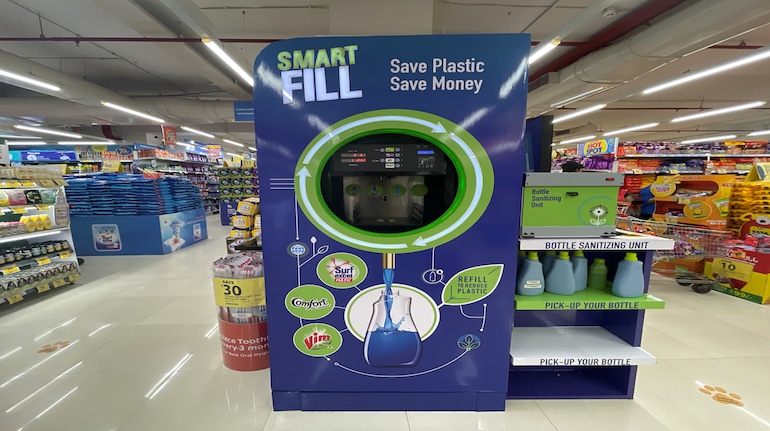
From a business standpoint, HUL continues to remain on solid footing. The company commands a dominant presence in India’s FMCG sector, with a diversified portfolio spanning home care, personal care, foods, and refreshments. Brands such as Surf Excel, Rin, Lux, Dove, Lifebuoy, Sunsilk, Wheel, Bru, and Kwality Walls enjoy strong consumer recall and wide distribution reach. Even amid inflationary pressures and fluctuating input costs, HUL has demonstrated its ability to protect margins through calibrated price hikes, cost efficiencies, and premiumization strategies.

The company’s management has consistently focused on volume-led growth, rural demand recovery, and innovation-led expansion. Recent quarters have shown gradual improvement in demand conditions, particularly in urban markets, while rural consumption has begun to stabilize. In this context, the tax demand episode is widely viewed as a legal and procedural issue rather than a business risk, with no bearing on HUL’s long-term growth trajectory.

For shareholders and analysts, the key takeaway is HUL’s clear and transparent communication. By promptly disclosing the tax demand and reaffirming its negligible impact on operations, the company has sought to eliminate uncertainty and speculation. As the matter moves through the appellate process, it is expected to remain a background development rather than a defining factor for the stock’s performance.

In conclusion, while the ₹1,559 crore income tax demand for FY22 may appear significant at first glance, Hindustan Unilever Limited’s strong fundamentals, proven legal track record, and confident management stance suggest that the issue is unlikely to disrupt its business momentum. As India’s FMCG leader continues to focus on growth, innovation, and consumer value creation, this development is seen as a manageable challenge rather than a cause for concern.

RELIANCE (RIL) Q3 Update: Reliance Industries to announce third-quarter results on January 16

MONEY CONTROL DETAILED NEWS ON RELIANCE Q3 UPDATE

Reliance Industries Q3 Results: All Eyes on January 16 Announcement

Reliance Industries Limited (RIL), India’s largest and most valuable listed company, is set to announce its third-quarter (Q3) financial results on January 16, drawing significant attention from investors, analysts, and the broader market. Led by billionaire Mukesh Ambani, the diversified conglomerate operates across energy, petrochemicals, retail, telecommunications, and emerging green energy segments. As expectations build ahead of the earnings release, market participants are closely evaluating how Reliance has navigated a challenging global environment while continuing to scale its consumer and digital businesses.

Oil-to-Chemicals Segment Faces Global Headwinds

Reliance’s traditional oil-to-chemicals (O2C) business is expected to report a mixed performance in the third quarter. Volatility in crude oil prices, softer global demand, and pressure on refining margins may impact profitability. However, analysts believe that Reliance’s massive scale, integrated operations, and operational efficiencies could help mitigate some of these challenges. Any improvement or stabilization in refining and petrochemical margins would be viewed positively by the market. Investors will pay close attention to management commentary on refining spreads, export demand, and the outlook for global energy markets.

Retail Business Likely to Shine During Festive Quarter

The spotlight is firmly on Reliance Retail, which is widely expected to deliver strong growth in Q3, supported by the festive season and sustained expansion across physical and digital channels. Robust demand in categories such as grocery, fashion, electronics, and consumer durables is likely to have driven higher revenues. Market participants will look for updates on same-store sales growth, margins, and the pace of new store additions, as Reliance Retail continues to consolidate its position as India’s largest and fastest-growing retail chain.

Jio Platforms to Deliver Stable Telecom Performance

Jio Platforms, the digital and telecom arm of Reliance Industries, is anticipated to post stable operational metrics during the quarter. Analysts expect steady subscriber additions, healthy growth in data usage, and stable average revenue per user (ARPU). With the Indian telecom industry moving toward a more rational pricing structure, investors will be keen to hear management’s views on potential tariff hikes, customer monetization, and growth opportunities in digital services, cloud computing, and enterprise solutions. Jio’s long-term growth prospects remain a key pillar of Reliance’s overall valuation.

Focus on New Energy and Future Investments

Beyond its core businesses, the market will closely track updates on Reliance’s new energy initiatives, including green hydrogen, solar module manufacturing, and battery storage solutions. While these segments are still in the investment phase, any clarity on project timelines, strategic partnerships, or capital expenditure plans could influence long-term investor sentiment. Reliance’s strong balance sheet and disciplined investment approach continue to provide comfort to stakeholders amid ongoing expansion.

What Investors Can Expect Going Forward

As Reliance Industries prepares to unveil its Q3 results on January 16, expectations remain cautiously optimistic. While near-term challenges persist in the global energy landscape, the company’s robust retail and telecom businesses, combined with its forward-looking investments in renewable energy and digital platforms, position it well for sustainable long-term growth. The upcoming earnings announcement and management commentary are expected to offer crucial insights into business performance, strategic direction, and the outlook for the remainder of the financial year, making this a key event for Indian equity markets.

BHEL hits 10% lower circuit as report says India may ease curbs on Chinese firms bidding for govt contracts

BHARAT HEAVY ELECTRICALS LIMITED (BHEL)- Today’s closing price and more information on NSE.

BHEL news by money control

BHEL IPO Buzz: A New Dawn for India’s Power Giant or Just a Market Mirage?

New Delhi, India — January 8, 2026 — Markets are abuzz with speculation about a possible BHEL IPO or divestment move as one of India’s most iconic public sector undertakings, Bharat Heavy Electricals Limited (BHEL), continues to capture investor imagination. Although the company is already publicly listed, renewed chatter in financial circles suggests potential strategic share sales or expansion capital raising could be on the horizon — triggering fresh debates among investors, analysts, and policymakers alike.

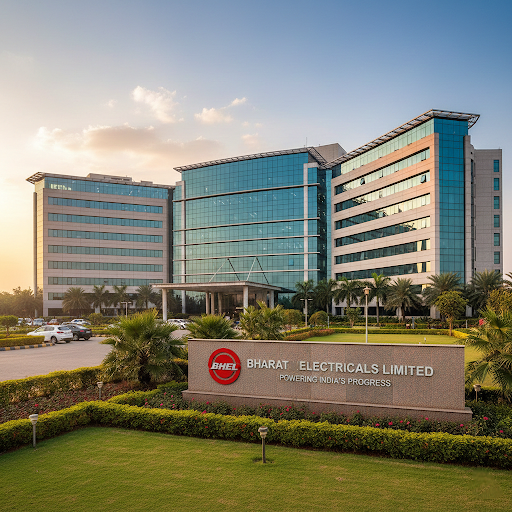
BHEL, India’s largest electrical equipment maker and a Navratna PSU under the Ministry of Heavy Industries, has long been a stalwart in the nation’s industrial and power infrastructure landscape. Known for manufacturing boilers, turbines, generators and now even forays into hydrogen and rail-related technologies, BHEL has played a central role in building India’s power backbone for decades. Wikipedia

Why the IPO Talk Now?

Although there is no official confirmation from BHEL or the Government of India about a fresh IPO (public offering) or follow-on public offering (FPO) at this point, market discussions have surged following sustained stock rallies and strong business fundamentals that many see as ripe conditions for capital raising. Recently, BHEL shares rallied over 44% in four months, hitting multi-month highs — a performance that has reinvigorated investor interest. Business Standard

At the same time, market participants note that PSU divestment remains a priority for the Indian government to unlock value and improve efficiency, and partial stake sales in major PSUs including BHEL have been discussed periodically in policy circles. Historically, BHEL has seen stake sales and discussions around further divestment, though nothing concrete has yet been launched. This backdrop fuels speculation that an IPO-like move — whether through offer for sale (OFS) or another mechanism — could be considered in the near term to attract fresh capital and broaden the shareholder base.

Business Momentum Adds Fuel to Market Optimism

Investors aren’t just talking — they’re backing optimism with action. BHEL’s share price strength has been accompanied by other positive signals:

  • Strong order book and revenue growth: BHEL reported robust revenue growth with significant order inflows in recent fiscal years, keeping its project pipeline healthy and visible. Bharat Heavy Electricals Limited
  • Investor sentiment: Call option activity has surged, hinting at bullish expectations among traders ahead of key financial announcements. Markets Mojo
  • Strategic partnerships: The company’s entry into new tech fields, such as hydrogen fuel systems and advanced rail equipment, adds a growth narrative that resonates with long-term investors. Business Standard

These trends have made BHEL not just a share to watch — but potentially a candidate for strategic capital market moves should the government choose to pursue a fresh public offering, OFS, or stake dilution to raise funds for modernization and expansion.

Caution in the Midst of Excitement

Despite strong performance, there are also headwinds. Recent policy rumblings about easing restrictions on Chinese firms participating in Indian government contracts saw BHEL’s stock slide sharply in intraday trading — reminding investors that regulatory changes can move markets just as quickly as optimism. Angel One

Moreover, quarterly earnings and profitability can still fluctuate in capital-intensive sectors, meaning any formal IPO plan would need careful timing and clear strategic rationale.

WHAT’S NEXT ?

While formal announcements about a BHEL IPO remain unconfirmed, the conversation itself underscores the company’s enduring importance and market appeal. Whether through an actual new public offer or strategic divestment/OFS, BHEL is at the center of one of India’s most watched PSU investment narratives — one that blends deep industrial heritage with fresh growth aspirations.

For the latest updates and official prospectus details, check announcements on the BSE/NSE and SEBI filings regularly.

Torrent Pharmaceuticals raise up to Rs 12,500 crore ($1.4 billion) through short-duration bond sales.

Torrent also plans to raise Rs 1,500 crore via commercial paper.

Torrent Pharma Lines Up Mega $1.4 Billion Bond Sale to Fuel Strategic Acquisition

Mumbai, India – January 8, 2026 — In a bold move that underscores its ambitions to transform into one of India’s most dominant pharmaceutical players, Torrent Pharmaceuticals is preparing to launch a mega bond sale worth up to ₹12,500 crore (approximately $1.4 billion) in January. The primary aim of this capital raise is to fund the company’s ongoing acquisition of a controlling stake in JB Chemicals & Pharmaceuticals, a deal that industry watchers say could reshape the competitive landscape of India’s drug market. The Economic Times+1

Strategic Financing Through Bonds

According to multiple banker sources, Torrent Pharma plans to issue short-duration corporate bonds with maturities ranging from one to five years. These bonds are expected to be rated AA+ by India Ratings and Research — a strong grade that reflects confidence in the company’s creditworthiness and future prospects. Once finalized, these bonds will be opened for bidding on electronic platforms early next month. Moneycontrol+1

In addition to the bond sale, Torrent is planning to raise another ₹1,500 crore through commercial paper, another short-term debt instrument. This blended debt strategy aims to balance cost and maturity while unlocking the liquidity needed to close the acquisition efficiently. Moneycontrol

🔗 Read the full Reuters-based report here:
Original Reuters story on Torrent Pharma bond sale

Why This Acquisition Matters

Torrent’s acquisition of JB Chemicals & Pharmaceuticals isn’t just a routine corporate transaction — it’s a strategic leap into higher growth and broader market influence. The deal, valued on an equity basis at around ₹25,700 crore, involves buying a controlling stake from global investment firm KKR and will later be followed by a merger of the two companies. Moneycontrol+1

Once completed, this acquisition is expected to elevate Torrent Pharma to one of the top five pharmaceutical firms in India, significantly increasing its market share across key therapeutic categories, including chronic and acute care segments. The Times of India

🔗 More on the broader acquisition strategy:
Torrent’s strategic acquisition of JB Chemicals & Pharmaceuticals

Debt Strategy That Makes Sense

Companies often turn to the bond markets when they have strong credit profiles and investors are open to longer-tenor private placements. In Torrent’s case, this approach allows the firm to tap into India’s deepening bond market rather than relying entirely on bank credit or foreign borrowing, which can come with higher costs and currency risks. The Economic Times

The AA+ rating on the issuance is a positive signal — it suggests that rating agencies believe Torrent’s future cash flows, post-acquisition, will comfortably support the higher leverage. The acquisition deal itself is also expected to be EPS accretive, meaning it could boost Torrent’s earnings per share once synergies from the merger materialize. TradingView

Market Reaction and Broader Impacts

Early market reactions suggest that analysts view the bond sale and acquisition as confidence-inspiring steps for the company’s long-term roadmap. By securing structured funding first, Torrent Pharma positions itself to avoid rushed financing closer to the acquisition closing date, and perhaps negotiate better terms with lenders and investors alike. VCCircle

Sector observers also point out that this transaction highlights an evolving trend where Indian corporates increasingly leverage domestic debt markets to fund large strategic buyouts — a shift from the traditional reliance on bank loans or overseas funding routes. Moneycontrol

Looking Ahead: Integration and Growth

While the bond sale is crucial to securing funds, execution of the acquisition and smooth integration with JB Chemicals will ultimately determine the success of Torrent Pharma’s ambitious strategy. Analysts suggest that if Torrent can effectively integrate product portfolios, streamline operations, and harness combined sales forces, this could be a transformational moment in India’s pharma sector. Business Today

Investors and industry stakeholders are now closely watching for the official bond issue launch, expected in the coming weeks, and for updates on regulatory approvals and merger timelines.

1)TRENT & TITAN NEWS

Forget defensives: Morgan Stanley is ‘Overweight’ on 3 sectors-TRENT, TITAN, 8 more in 2026 focus list

3 Sectors – Trent, Titan, 8 More in 2026 Focus List

In a major update to its 2026 outlook published today, global investment bank Morgan Stanley has signaled a clear shift in strategy, urging investors to shift away from defensive sectors and focus on three key growth-oriented areas of the Indian market. According to its latest research note, the brokerage believes that the stage is being set for a broader equity rally in India next year, underpinned by supportive macroeconomic trends, easing financial conditions and rising domestic demand. The Financial Express

Morgan Stanley’s strategy, branded internally as “The Coming Upside Surprise,” calls for an ‘Overweight’ stance on Consumer Discretionary, Industrials and Financials, as these sectors stand to benefit the most from India’s evolving economic cycle. The brokerage’s base case forecasts the benchmark Sensex hitting 95,000 by December 2026, roughly a 13% rise from current levels, while a more optimistic bull case model pegs the index around 107,000, implying as much as 26% upside potential. The Financial Express

Macro Tailwinds and the Shift From Defensives

Morgan Stanley’s call comes against a backdrop of shifting macroeconomic conditions. After several years of hawkish monetary policy, the report argues that the macro setup is turning more favorable, thanks in part to fiscal policy support and structural reforms. A key catalyst cited by analysts is the recent GST rate cuts totaling nearly ₹1.5 trillion, aimed at boosting mass consumption across the country. This, combined with a relatively undervalued Indian rupee and rising nominal growth, has created a compelling backdrop for cyclical equities to outperform defensive categories. The Financial Express

Accordingly, the brokerage has underweighted Assets traditionally viewed as safe havens — including Materials, Energy, Healthcare and Utilities — believing that capital will rotate into higher-beta, domestic growth plays as confidence returns. The Financial Express

Overweight Sectors: The Engine of 2026

1. Consumer Discretionary (Overweight by 300 bps)
Morgan Stanley expects a robust revival in household spending, especially in urban and mass-market segments. This is supported by tax relief, easing interest rates and pent-up demand for discretionary goods and services. Notable picks in this category include Trent, which benefits from broader retail growth; Titan, with exposure to luxury and lifestyle consumption; and Maruti Suzuki, a proxy for a rebound in passenger vehicle demand. Varun Beverages is another consumer name on the list, riding mass consumption trends. The Financial Express

2. Industrials (Overweight by 300 bps)
With the Indian government front-loading capital expenditure and private companies beginning to spend on new capacity, industrial stocks are expected to enjoy multi-year visibility. Heavyweights like Larsen & Toubro (L&T) stand to benefit from infrastructure rollouts, while UltraTech Cement plays directly into the construction and urban development theme. The Financial Express

3. Financials (Overweight by 200 bps)
Morgan Stanley sees compelling value in both traditional banking and non-bank financial companies, citing deregulation, rising credit demand from small-medium enterprises and improving asset quality. ICICI Bank and Bajaj Finance are highlighted for their strong credit growth potential and improving margins. The Financial Express

High Conviction Focus List

Beyond assigning sector weights, Morgan Stanley has compiled a 12-stock focus list representing its top high-conviction ideas for 2026. These include:

  • Reliance Industries — diversified play across energy, telecom and retail
  • ICICI Bank — financials
  • Maruti Suzuki — consumer cyclical
  • Larsen & Toubro — infrastructure/industrial
  • Bajaj Finance — NBFC/credit growth
  • Titan and Trent — consumption bets
  • UltraTech Cement and Varun Beverages — infrastructure and broad consumption
  • Coforge — a tech play rounding out the list. The Financial Express

Each of these companies has been given a 12-month base case target price — ranging from ₹740 for Varun Beverages to ₹13,800 for Maruti Suzuki — with implied upside potential based on current valuations. The Financial Express

The “Pain Trade” and Broader Market Sentiment

A noteworthy observation in the Morgan Stanley report is the positioning of Foreign Portfolio Investors (FPIs). The bank notes that FPI ownership in Indian equities has been at historically low levels over the past four years. As India’s market performance begins to outpace global peers, Morgan Stanley believes that these investors may be forced to return to equities at higher prices to stay aligned with benchmark exposures — a dynamic it describes as the potential technical “pain trade” that could provide additional upside momentum. The Financial Express

Overall, Morgan Stanley’s call to move away from traditional defensive sectors and lean into domestic growth stories reflects a broader conviction that India’s market may be entering a new phase of sustained cyclical recovery — one driven by robust consumption, infrastructure development and financial sector expansion. Investors tracking the brokerage’s outlook will likely watch upcoming macro data and corporate earnings closely to validate this thematic shift.

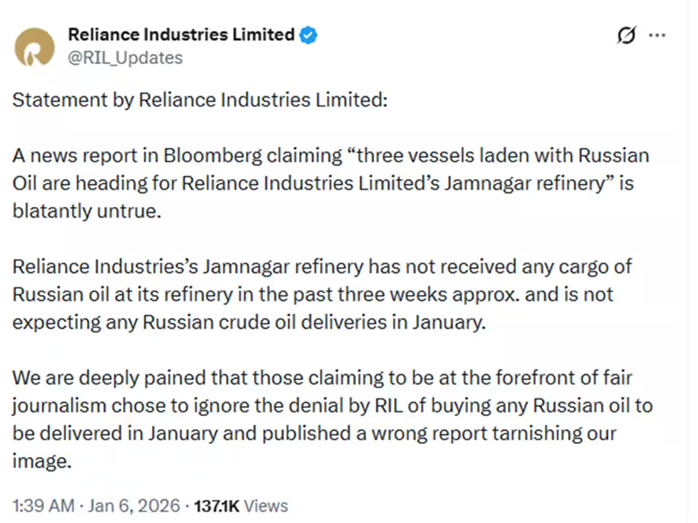
Reliance Industries (RIL) rejects claims of Russian oil cargoes coming to Jamnagar refinery: ‘Blatantly untrue’.

The reliance clarifies about the Russian oil barrels coming to Jamnagar. Reliance says no Russian oil barrels are coming to Jamnagar. adding that it didn’t have any committed shipments of Russian crude for delivery in January 2026.

Reliance share price fell on 6th of January 2026 about 4.46%. Reliance share price on 6th of January 2026 was Last traded price (LTP) 1507.60 .

Reliance Industries Ltd (RIL) has strongly dismissed reports suggesting that Russian oil cargoes are being delivered to its Jamnagar refinery, calling such claims “blatantly untrue” and misleading. The company clarified that these allegations are entirely baseless and do not reflect its procurement practices. RIL emphasised that its crude sourcing strategy is guided by commercial considerations, regulatory compliance, and long-term supply agreements, and that it remains fully aligned with all applicable international trade norms and sanctions frameworks.

In a firm rebuttal, Reliance stated that speculative reports linking its Jamnagar operations to Russian oil imports are incorrect and risk creating unnecessary confusion about the company’s global sourcing and refining operations. The Jamnagar refinery complex, one of the largest and most sophisticated in the world, processes a diversified basket of crude oils sourced from multiple geographies to ensure operational efficiency and energy security. RIL reiterated its commitment to transparency and responsible business conduct, underlining that any claims to the contrary are not supported by facts and should be viewed with caution.

RELIANCE NEWS BY MONEY CONTROL

Read the full Moneycontrol article on RIL’s rejection of the Russian oil cargo claims

TRENT shares fall 9%: On 6th of January 2026 company released provisional results for Q3 FY26

Trent Q3 business update by Money control

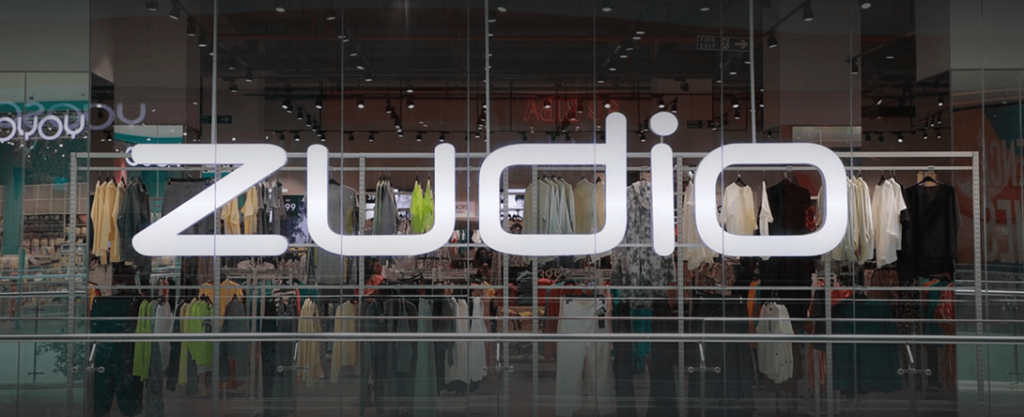
Trent released its  business update for the October-December quarter of FY26 in the post market hours of January 5. The company reported standalone revenue from sale of products at Rs.5,220 crore during the quarter. This marks a 17 percent year-on-year (YoY) rise from the Rs.4,466 crore reported in the same period of the previous financial year.

Notably, the Zudio and Westside-parent’s revenue from operations had risen more than 17 percent YoY to Rs.4,724 crore during Q2 FY26, same as the revenue growth reported in Q3.

Market underperformance: For the year, the stock has been under pressure and slipped sharply compared with broader indices.

Motilal Oswal on Trent:

Motilal Oswal Financial Services noted that the revenue growth reported by Trent is lower than the 20 percent revenue growth estimated by the brokerage. It however noted that the revenue growth remained steady at 17 percent YoY after several quarters of revenue growth deceleration.

Revenue growth is primarily driven by an approximately 28 percent YoY increase in store count, with revenue per store declining around 11 percent YoY, indicating continued cannibalization in store-level sale, it added.

“Trent’s stock price had run up in the last few days (up ~9% since 19th Dec’25) on expectations of a pick-up in revenue growth. A weaker-than-expected number could weigh on the recent stock price recovery as earnings downgrades are likely to continue in the near term,” Motilal said, while keeping a ‘Buy’ call on the stock.

Why the Stock Fell Despite Growth

Q3FY26 report reaction: Trent did report 17% year-on-year revenue growth for the December quarter, but this fell short of what many investors and analysts expected.

Moderating growth concerns: Markets were unimpressed because the pace of growth has slowed, and in some metrics like same-store sales and revenue per square foot, performance wasn’t strong enough relative to high expectations.

High valuation risk: Trent trades at relatively high valuation multiples, so even a modest miss or slowing momentum can trigger steep selling.

Profit-booking & sentiment: Some selling has also been attributed to short-term profit booking after recent gains, as well as broader caution in retail stocks.