
Table of Contents
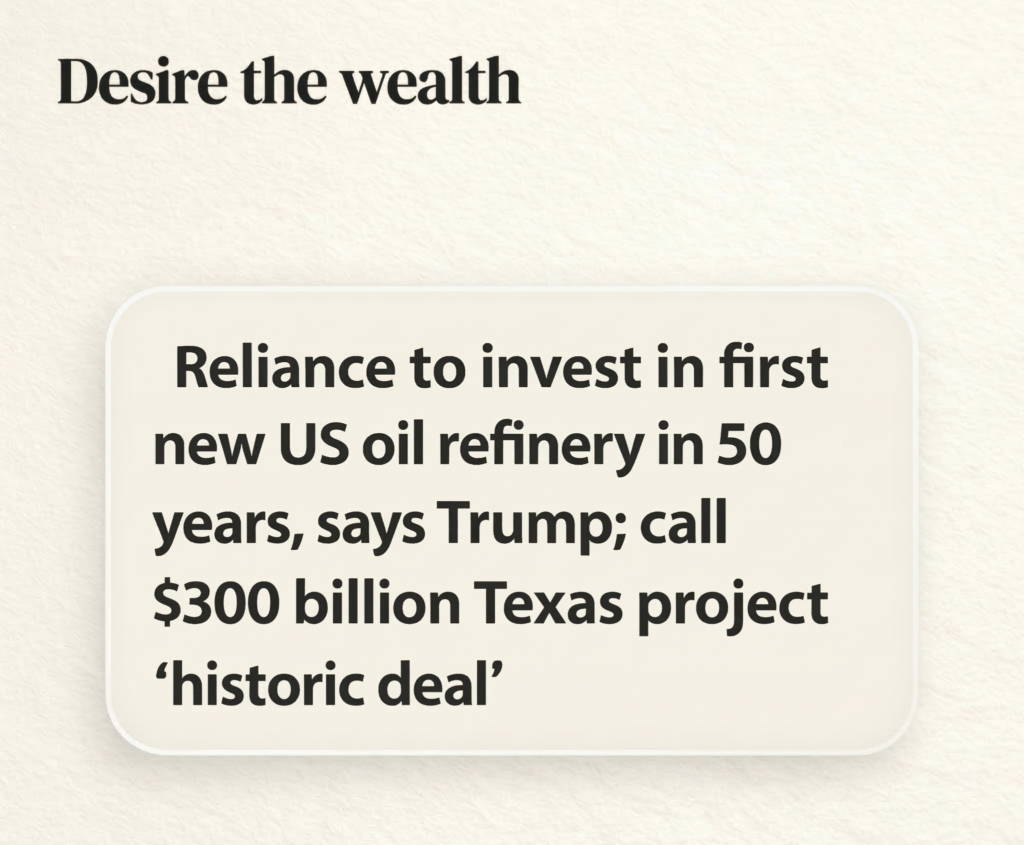
Trump Hails ‘Historic’ $300 Billion Texas Oil Refinery Deal with Reliance Industries: A New Era of Global Energy Dominance
In a move that has sent shockwaves through the global energy markets, U.S. President Donald Trump has announced a “historic $300 billion deal” to construct the first major new oil refinery in the United States in over 50 years. At the heart of this massive infrastructure project is an unprecedented partnership with India’s largest private-sector conglomerate, Reliance Industries (RIL), led by billionaire Mukesh Ambani.
The project, spearheaded by America First Refining (AFR), is set to be located at the Port of Brownsville, Texas. Trump characterized the development as a “massive win for American workers” and a cornerstone of his “America First” energy agenda, aimed at securing total energy independence amid escalating global geopolitical tensions.
Key Insights: Why This Deal Matters
- End of a 50-Year Drought: This is the first “grassroots” refinery (built from the ground up) in the U.S. since 1977.
- Massive Scale: The $300 billion figure represents the estimated total economic value of the 20-year offtake and production agreement.
- Strategic Reliance Partnership: Reliance Industries is providing a “nine-figure investment” and has signed a binding 20-year agreement to purchase and distribute the refinery’s products.
- Shale-Optimized Technology: Unlike older U.S. refineries designed for heavy foreign crude, this facility will process 100% American light shale oil.
- Geopolitical Timing: The announcement comes as the Strait of Hormuz faces disruptions and oil prices hover near $100–$120 per barrel due to the conflict in West Asia.
The $300 Billion Vision: Breaking Down the Numbers
While the construction cost of a modern refinery typically ranges between $6 billion and $10 billion, the $300 billion valuation cited by President Trump encompasses the long-term trade impact and production value.
According to filings from America First Refining, the deal involves:
- Processing Power: The refinery will process roughly 1.2 billion barrels of U.S. light shale oil over two decades.
- Product Value: It is expected to produce 50 billion gallons of refined products (gasoline, diesel, and jet fuel) worth an estimated $175 billion.
- Trade Balance: The project is projected to improve the U.S. trade imbalance by $300 billion by reducing the need for imported refined products and boosting global exports.
“This is what American Energy Dominance looks like. We are streamlining permits and lowering taxes to bring billions of dollars back to our nation,” Trump stated via Truth Social.
Reliance Industries: The Global Powerhouse in Texas
The involvement of Reliance Industries is a masterstroke of global diplomacy and corporate strategy. Reliance already operates the world’s largest single-location refining complex in Jamnagar, India. By investing in the Brownsville project, Mukesh Ambani is effectively exported Reliance’s world-class refining expertise to American soil.
For Reliance, this move provides a critical hedge. As India faces its own energy challenges due to the Iran-Israel conflict, securing a 20-year supply chain of refined products from the U.S. ensures long-term stability for its global trading desk.
Why Brownsville, Texas?
The Port of Brownsville is strategically located near the Permian Basin, the most productive oil field in the U.S. By refining shale oil at the source, the new facility eliminates the “mismatch” currently plaguing the Gulf Coast—where 50-year-old refineries are often unable to efficiently process the light, sweet crude produced by the American shale revolution.
Economic Impact: Jobs and Energy Security
The Texas refinery is expected to be “the cleanest refinery in the world,” utilizing next-generation carbon-capture and hydrogen-ready technologies. Beyond environmental benchmarks, the economic ripples will be felt immediately:
- Job Creation: Thousands of high-paying construction and engineering jobs are expected during the groundbreaking, scheduled for Q2 2026.
- National Security: By processing domestic shale into fuel, the U.S. becomes less vulnerable to “actuarial warfare”—where maritime chokepoints like the Strait of Hormuz can be closed by rising insurance costs or military conflict.
- Consumer Relief: Though the refinery will take years to become fully operational, the announcement serves as a signal to markets that long-term supply is being addressed, potentially stabilizing volatile gas prices.
Technical Innovation: “The Cleanest Refinery in the World”
While critics often argue that new oil infrastructure is a step backward for the environment, America First Refining has countered this by positioning the Brownsville plant as a Green-Refining Hybrid.
Key technical features include:
- Hydrogen Integration: The facility will use green hydrogen for the desulfurization process, significantly reducing its carbon footprint.
- Zero-Liquid Discharge: Advanced water recycling systems will ensure that no industrial wastewater is released into the local ecosystem—a critical promise for the delicate coastal environment of South Texas.
- Modular Design: Unlike the sprawling, inefficient plants of the 1970s, this refinery uses a modular architecture that allows for rapid construction and future upgrades for biofuels or synthetic fuels.
The “Trump-Ambani” Synergy: A Match Made in Energy Heaven
The partnership between Donald Trump and Mukesh Ambani represents a fusion of “America First” nationalism and “Global India” ambition. Ambani’s Reliance Industries is not just a passive investor; they are the operators of the future.
Reliance’s Jamnagar complex is a marvel of engineering that operates at over 100% capacity and can process almost any type of crude. By bringing this operational excellence to Texas, Reliance is helping the U.S. overcome its “infrastructure amnesia”—the loss of technical know-how that occurs when an industry goes 50 years without building a new flagship facility.
Market Reaction: Why RIL Stock Dipped Despite the News
Interestingly, while the news is “historic,” Reliance Industries (RIL) shares saw a slight 0.5% dip on the NSE following the initial 2% rally. Financial analysts suggest this is a “wait-and-see” reaction from institutional investors.
- Capital Expenditure Concerns: A project of this magnitude requires significant upfront cash. Investors are looking for clarity on the debt-to-equity ratio Reliance will use for its “nine-figure” investment.
- Timeline Risks: Building a refinery takes years. While the Q2 2026 groundbreaking is ambitious, regulatory hurdles and construction delays are common in large-scale energy projects.
- Long-Term Offtake: The 20-year binding agreement is a double-edged sword. It guarantees revenue, but it also locks Reliance into a specific pricing structure in a world where the energy transition is accelerating.
Regional Impact: South Texas as the New “Silicon Valley of Energy”
The Port of Brownsville and the surrounding Rio Grande Valley have long been overlooked in the Texas energy boom. This deal changes that overnight.
- Thousands of Jobs: The project is expected to create 10,000+ construction jobs and 1,500 permanent high-skilled roles.
- Economic Opportunity Zone: Being located in a designated Opportunity Zone, the project provides massive tax incentives for the developers while bringing infrastructure like new roads, power grids, and housing to the local community.
- Education and Training: Local universities and trade schools in South Texas are already preparing to launch specialized “Refinery Tech” programs to feed the workforce pipeline.
Final Verdict: A $300 Billion Gamble on the Future of Oil
As we move deeper into 2026, the Reliance-Texas deal stands as a bold bet that oil will remain the bedrock of global power for decades to come. By combining American resources with Indian refining expertise and Trump’s deregulatory “America First” policies, this project aims to rewrite the rules of the energy market.
It is a deal of superlatives: the first in 50 years, the biggest in history, and potentially the most consequential for the 21st-century global economy.